Insurance for your new diamond and any future piece of luxurious jewelry can prove to be very valuable
Often times the price of the wedding ring can be similar to the value of the car you own. If you own car insurance, don’t you think it may be wise to do the same for your cherished diamond.
Tricks-4-free is now about everything! From Free downloads, Free tricks, FREE INFORMATION! You can also Request for tricks! just Send us a request at: theschoolguide@gmail.com
Showing posts with label Jewelries. Show all posts
Wednesday, April 06, 2011
Monday, March 21, 2011
Know More About Wholesale Fashion Jewelries
What comes first into our mind when we say...wholesale fashion jewelries? Isn't it acquiring the items in bulk at a cheaper way? Now a day's there are a lot of stores or company's that offer wholesale items. They offer limited discounts or even free shipping to clients who purchase in bulk. They may be in dozens or per pack at a minimum price one can afford. It is really apt for the clients to choose from their great selections
Fashion jewelry has a lot of variations, one of them is what we call the body jewelry. This body jewelry includes: nipple rings, gold body jewelry, eyebrow rings, labrets, nose rings, belly button rings, and navel rings, tongue rings, piercing rings, piercing jewelry, tongue barbells and more. One could find these items at a cheaper price since there are a lot of online companies that already offer wholesale deals. Body jewelry are so hot and fashionable these days...many are hooked to the trend as it gives a unique look to a person no matter what the culture maybe.
Labels:
Jewelries
Saturday, March 05, 2011
What You Need To Know To Choose A Diamond With Confidence
Most people are unaware of the role diamonds play in bringing real benefits to people in the countries around the world where diamonds are sourced. Nowhere is this more evident than in Africa. It is also in Africa that
this same resource has been used to fund conflict. In 2000, a coalition of governments, non-governmental organizations and the diamond industry worked together to address this issue. In 2002, they established the Kimberley Process Certification System, a UN-backed process that has virtually eliminated the trade in conflict diamonds. Today, over 99% of the world's supply of diamonds is from sources free of conflict. Diamondfacts.org is dedicated to presenting the facts about conflict diamonds, along with how diamonds are driving economic growth and prosperity in countries around the world. Please, Learn more about buying diamonds from sources free from conflict, and about the important role diamonds play in many developing economies. Download More Information.
Fact #1: An estimated 5 million people have access to appropriate healthcare globally thanks to revenues from diamonds.
Fact #2: Conflict diamonds have been reduced from approximately 4% to considerably less than 1% since the implementation of the Kimberley Process in 2003.
Fact #3: An estimated 10 million people globally are directly or indirectly supported by the diamond industry.
Fact #4: The diamond mining industry generates over 40% of Namibia's annual export earnings.
Fact #5: Diamond revenues enable every child in Botswana to receive free education up to the age of 13.
Fact #6: In July 2000, the global diamond industry announced its zero-tolerance policy towards conflict diamonds and continues to drive this policy.
Fact #7: Sierra Leone is now at peace and exported approximately $142 million diamonds in 2005.
Fact #8: Approximately one million people are employed by the diamond industry in India.
Fact #9: Approximately $8.4 billion worth of diamonds a year come from African countries.
Fact #10: More than 99% of diamonds are now from conflict free sources and traded under the UN-mandated Kimberley Process.
Fact #11: The Diamond Development Initiative was established to improve the working conditions of artisanal miners.
Fact #12: The revenue from diamonds is instrumental in the fight against the HIV/AIDS pandemic.
Fact #13: Under the Kimberley Process, rough diamonds can only be exported and imported when accompanied by a certificate from the exporting country.
Fact #14: The charity Jewelers for Children funds a community based care program for orphaned children in South Africa.
Fact #15: An estimated 65% of the world's diamonds come from African countries.
Fact #16: Today, 71 governments and the legitimate diamond industry are all committed and legally bound to eradicating conflict diamonds.
Fact #17: The diamond industry has introduced a system to help give greater assurances to retailers and to provide consumers with the reassurance that their diamond is from a conflict free source.
Fact #18: Diamonds account for 33% of the GDP (approximately $3 billion) of Botswana. Since diamonds were discovered in Botswana, GDP annual growth rate has averaged 7%.
Fact #19: Major world leaders - including Nelson Mandela - have cited the importance of diamonds to the lives of African people.
Fact #20: It is estimated that one million people work in the informal (astisanal) alluvial diamond digging sector.
Fact #21: Some diamond producing countries are not Kimberley Process compliant.
Fact #22: In November, 2006, 71 Governments, leading NGOs, and the World Diamond Council agreed on measures to further strengthen the Kimberley Process.
Fact #23: At the 2006 Kimberley Process Plenary, the industry committed funds and resources to address challenges faced by countries with a high prevalence of artisanal alluvial mining.
this same resource has been used to fund conflict. In 2000, a coalition of governments, non-governmental organizations and the diamond industry worked together to address this issue. In 2002, they established the Kimberley Process Certification System, a UN-backed process that has virtually eliminated the trade in conflict diamonds. Today, over 99% of the world's supply of diamonds is from sources free of conflict. Diamondfacts.org is dedicated to presenting the facts about conflict diamonds, along with how diamonds are driving economic growth and prosperity in countries around the world. Please, Learn more about buying diamonds from sources free from conflict, and about the important role diamonds play in many developing economies. Download More Information.
Fact #1: An estimated 5 million people have access to appropriate healthcare globally thanks to revenues from diamonds.
Fact #2: Conflict diamonds have been reduced from approximately 4% to considerably less than 1% since the implementation of the Kimberley Process in 2003.
Fact #3: An estimated 10 million people globally are directly or indirectly supported by the diamond industry.
Fact #4: The diamond mining industry generates over 40% of Namibia's annual export earnings.
Fact #5: Diamond revenues enable every child in Botswana to receive free education up to the age of 13.
Fact #6: In July 2000, the global diamond industry announced its zero-tolerance policy towards conflict diamonds and continues to drive this policy.
Fact #7: Sierra Leone is now at peace and exported approximately $142 million diamonds in 2005.
Fact #8: Approximately one million people are employed by the diamond industry in India.
Fact #9: Approximately $8.4 billion worth of diamonds a year come from African countries.
Fact #10: More than 99% of diamonds are now from conflict free sources and traded under the UN-mandated Kimberley Process.
Fact #11: The Diamond Development Initiative was established to improve the working conditions of artisanal miners.
Fact #12: The revenue from diamonds is instrumental in the fight against the HIV/AIDS pandemic.
Fact #13: Under the Kimberley Process, rough diamonds can only be exported and imported when accompanied by a certificate from the exporting country.
Fact #14: The charity Jewelers for Children funds a community based care program for orphaned children in South Africa.
Fact #15: An estimated 65% of the world's diamonds come from African countries.
Fact #16: Today, 71 governments and the legitimate diamond industry are all committed and legally bound to eradicating conflict diamonds.
Fact #17: The diamond industry has introduced a system to help give greater assurances to retailers and to provide consumers with the reassurance that their diamond is from a conflict free source.
Fact #18: Diamonds account for 33% of the GDP (approximately $3 billion) of Botswana. Since diamonds were discovered in Botswana, GDP annual growth rate has averaged 7%.
Fact #19: Major world leaders - including Nelson Mandela - have cited the importance of diamonds to the lives of African people.
Fact #20: It is estimated that one million people work in the informal (astisanal) alluvial diamond digging sector.
Fact #21: Some diamond producing countries are not Kimberley Process compliant.
Fact #22: In November, 2006, 71 Governments, leading NGOs, and the World Diamond Council agreed on measures to further strengthen the Kimberley Process.
Fact #23: At the 2006 Kimberley Process Plenary, the industry committed funds and resources to address challenges faced by countries with a high prevalence of artisanal alluvial mining.
How to sell you diamond jewelry
Trying to sell your Jewelry? You may have had the experience of trying to sell to places with signs, "Highest Prices Paid for Your Diamonds!", "Free Appraisals!". Was the offer price in a whole different category of prices than what you bought it for? Why do you think those appraisals are free? When someone is a buyer, they cannot offer an unbiased appraisal. They want to buy your jewelry for the lowest price possible.
Many people want to know where the best place is to sell their Jewelry. While there are many options, if you want to maximize the selling price, you're probably best off to bring your Jewelry to an Auction House, or listing it in a Classified ad. We offer a Jewelry Classified section and since its inception, most people seem to sell rather quickly if the seller provides enough documentation. You can also use Craigslist or eBay. The benefit of Craigslist is that due to the local nature of the ad, you might be able to meet the potential buyer face to face. Making both sides feel more comfortable. On the downside, you are likely to reach a smaller audience of potential buyers... Jewelry auctions for individuals on eBay are very hard and quite competitive. Between the fees and security needed to make the deal go through, it might not be the best bet. eBay seems to do better with other categories.
No matter which avenue you choose, make sure you find out what your Jewelry is worth first, through a totally independent appraiser. And be sure to obtain appropriate documentation. The buyer won't buy if they don't have enough information proving you are the owner of the Jewelry and are trustworthy enough to risk sending off funds.
Many people want to know where the best place is to sell their Jewelry. While there are many options, if you want to maximize the selling price, you're probably best off to bring your Jewelry to an Auction House, or listing it in a Classified ad. We offer a Jewelry Classified section and since its inception, most people seem to sell rather quickly if the seller provides enough documentation. You can also use Craigslist or eBay. The benefit of Craigslist is that due to the local nature of the ad, you might be able to meet the potential buyer face to face. Making both sides feel more comfortable. On the downside, you are likely to reach a smaller audience of potential buyers... Jewelry auctions for individuals on eBay are very hard and quite competitive. Between the fees and security needed to make the deal go through, it might not be the best bet. eBay seems to do better with other categories.
No matter which avenue you choose, make sure you find out what your Jewelry is worth first, through a totally independent appraiser. And be sure to obtain appropriate documentation. The buyer won't buy if they don't have enough information proving you are the owner of the Jewelry and are trustworthy enough to risk sending off funds.
Diamond Investment Facts - Must read
Many people think of diamonds as an investment and indeed, they can be very good investments. But before you get carried away, we of Jewelry industry would like to give you a few words of warning about this type of investment. These few words of advice can make the difference between a wise move on your part or a financial disaster.
Diamond Investment Facts
1. White diamonds that cost under $50,000 at a true wholesale price are not rare enough to be considered an investment except in a market that exhibits extreme inflation of the currency. Even then, these less expensive stones may drop dramatically in price when inflation is curbed. If you wish to possibly make a profit and have an easy time re-selling the stone, you have to buy a beautiful and rare enough stone so that there are more buyers than stones available at the time of resale.
2. The most common use of diamonds as an investment is as an insurance policy against the unexpected. High liability professionals buy important diamonds and often hide them offshore. In the case they end up on the wrong end of a civil law suit, they have a private source of wealth which can get them back on their feet. If the courts can't find an asset and don't know about, they cannot confiscate it. If the investment diamond is never used, it can be quietly passed on to the children in the estate.
3. Most people believe that DeBeers controls the market for diamonds and therefore they control the price. DeBeers does, to a great extent, control the distribution and base pricing of rough (uncut) diamonds. They do not, however, control the price of polished diamonds. Polished diamond prices fluctuate up and down and are highly impacted by things such as interest rates and inflation. During the high inflation period of 1978-1980 in the U.S., white diamonds were approximately 4 times more expensive than they are now in the late 1990's.
4. Buying an important or investment diamond at the right price is very critical. The world's diamond community essentially uses the Rapaport Diamond Report as a guide for buying and selling diamonds. No consumer can ever expect to make a profit on a diamond in a few years if they are buying at typical retail prices in stores. Buying a diamond with a GIA diamond grading report and at some kind of discount from the Rapaport wholesale price list (see our section on Rapaport) will help ensure that if diamonds go up over the years to come, the initial bid-ask spread will disappear and a profit may eventually be taken. A reputable dealer should be able to sell you certified diamonds for 5 - 10% over their cost. Any more than that and you are paying too much.
5. While fine, large 5+ carat white diamonds can make very acceptable long term investments, the diamonds with the best appreciation track record are natural fancy color diamonds such as yellow, pink , blue, green, purple and red. Since serious recording of prices started on these stones around 1970, they have never fallen in price. In recessions, they tend to move laterally and in healthy economies or inflationary times they tend to move up in price. Blue diamonds have approximately doubled in price every 5 years, pink diamonds have doubled in price about every 6-7 years and yellow diamonds have doubled in price about every 8-10 years since 1970. These diamonds are hundreds and thousands of times more rare than the finest "D" color diamonds. And, most famous diamonds are not white. Think about it! The Hope is blue and the Tiffany is yellow, just to mention two stones.
6. Top quality diamonds are more liquid than real estate but less liquid than stocks or gold. It will take some time to find a buyer for your stone. Interestingly, the more rare and pricey the stone, the easier it is to resell. There are so few truly magnificent diamonds and there is a lot of money in the world looking for that type of stone. It is much easier to sell a $100,000+ stone than a $1,000 stone.
7. Always buy an important stone with a GIA or EGL certificate. Most large and rare stones have a certificate that was issued at the time of cutting and will be recorded and will stay with it until it is reexamined for a specific reason, the number shop remain the same forever. This is the pedigree for the stone, your assurance of what you are buying and the future owner's assurance of what he/she is buying from you. Don't ever take the jeweler's or dealer's word on the quality of a stone, always insist on certification. Most truly important stones already have GIA or EGL certificates with them.
8. When in doubt, find a specialist in the field to help you.
9. Ask an EXPERT in a specific field that has experience and knowledge in the field.
Diamond Investment Facts
1. White diamonds that cost under $50,000 at a true wholesale price are not rare enough to be considered an investment except in a market that exhibits extreme inflation of the currency. Even then, these less expensive stones may drop dramatically in price when inflation is curbed. If you wish to possibly make a profit and have an easy time re-selling the stone, you have to buy a beautiful and rare enough stone so that there are more buyers than stones available at the time of resale.
2. The most common use of diamonds as an investment is as an insurance policy against the unexpected. High liability professionals buy important diamonds and often hide them offshore. In the case they end up on the wrong end of a civil law suit, they have a private source of wealth which can get them back on their feet. If the courts can't find an asset and don't know about, they cannot confiscate it. If the investment diamond is never used, it can be quietly passed on to the children in the estate.
3. Most people believe that DeBeers controls the market for diamonds and therefore they control the price. DeBeers does, to a great extent, control the distribution and base pricing of rough (uncut) diamonds. They do not, however, control the price of polished diamonds. Polished diamond prices fluctuate up and down and are highly impacted by things such as interest rates and inflation. During the high inflation period of 1978-1980 in the U.S., white diamonds were approximately 4 times more expensive than they are now in the late 1990's.
4. Buying an important or investment diamond at the right price is very critical. The world's diamond community essentially uses the Rapaport Diamond Report as a guide for buying and selling diamonds. No consumer can ever expect to make a profit on a diamond in a few years if they are buying at typical retail prices in stores. Buying a diamond with a GIA diamond grading report and at some kind of discount from the Rapaport wholesale price list (see our section on Rapaport) will help ensure that if diamonds go up over the years to come, the initial bid-ask spread will disappear and a profit may eventually be taken. A reputable dealer should be able to sell you certified diamonds for 5 - 10% over their cost. Any more than that and you are paying too much.
5. While fine, large 5+ carat white diamonds can make very acceptable long term investments, the diamonds with the best appreciation track record are natural fancy color diamonds such as yellow, pink , blue, green, purple and red. Since serious recording of prices started on these stones around 1970, they have never fallen in price. In recessions, they tend to move laterally and in healthy economies or inflationary times they tend to move up in price. Blue diamonds have approximately doubled in price every 5 years, pink diamonds have doubled in price about every 6-7 years and yellow diamonds have doubled in price about every 8-10 years since 1970. These diamonds are hundreds and thousands of times more rare than the finest "D" color diamonds. And, most famous diamonds are not white. Think about it! The Hope is blue and the Tiffany is yellow, just to mention two stones.
6. Top quality diamonds are more liquid than real estate but less liquid than stocks or gold. It will take some time to find a buyer for your stone. Interestingly, the more rare and pricey the stone, the easier it is to resell. There are so few truly magnificent diamonds and there is a lot of money in the world looking for that type of stone. It is much easier to sell a $100,000+ stone than a $1,000 stone.
7. Always buy an important stone with a GIA or EGL certificate. Most large and rare stones have a certificate that was issued at the time of cutting and will be recorded and will stay with it until it is reexamined for a specific reason, the number shop remain the same forever. This is the pedigree for the stone, your assurance of what you are buying and the future owner's assurance of what he/she is buying from you. Don't ever take the jeweler's or dealer's word on the quality of a stone, always insist on certification. Most truly important stones already have GIA or EGL certificates with them.
8. When in doubt, find a specialist in the field to help you.
9. Ask an EXPERT in a specific field that has experience and knowledge in the field.
Wednesday, March 02, 2011
Dealing with Tricks While Purchasing Diamond Jewelries
Despite the fact that one can find handful of straight up tricks as you buy a diamond ring there are certain techniques of the commerce which jewelers use to sell you the lowest quality stone in the maximum cost. Let's examine them all;
"Valentine's Day - Purchase 50-75% down all the things! "
This one makes me giggle. To tell the truth the majority of retailers distribute their expensive diamonds with a 200-300% mark-up on, consequently despite the presence of 75% off, you can be still paying 125% much more than you need to.
One more con to pay attention to is that this price tag lessening may well be off the 'Recommended Retail Price (RRP)'. The RRP is a selling price that the store has created itself, so it can certainly inflate the rrp, to generate it seem like you're finding a wonderful package!
One method to discover the best value could be to perform several research and then determine precisely what your diamond is worth simultaneously at various other stores and also on the internet.
"We primarily stock superior diamonds that are well cut, see how they shine"
The most wild ideas that you're going to uncover whenever you purchase a diamond ring stands out as the extremely properly lit up displays. Surely every diamonds is going to shimmer remarkably when it is lit up right from every point of view!
Before you'll buy a diamond ring make sure that you notice it beyond the brilliant lamps. All over again, check the grading certification to ascertain the grade of the chop.
"I'm sorry, that stone has been purchased, however , we do have got one similar"
It is amongst the most well-known scams in the book; 'sell' the gemstone that was publicized, however , offer you another that is a lot more steeply-priced. In case they don't possess a matching diamond in a very similar price to the one you wanted and you're not cheerful venturing into a higher quality diamond then simply get out of the retail store.
"This one is amongst the most well liked, all the young girls absolutely love it" or "If perhaps my sweetheart quizzed me, I'd want that one - it is gorgeous".
The supreme marketing device is the your thoughts. You are not going to buying a diamond ring for anybody else's sweetheart, or the store associate. Opt for what you prefer and which senses right for you and your romantic relationship.
"This specific ring contains fantastic value, and I guarantee that the evaluation equates at far more as compared to what you will shell out these days"
The top recommendation in case you are given this incentive is to call their bluff. Make sure they confirm written that your particular diamond definitely will appraise at a greater value as compared to what you are forking out, or they'll compensate you accordingly. Next take your diamond to an third party appraiser, not one that the shop advises!
If you're able to;
. carry out a bit of stone homework so that you have knowledge of the 4 C's of gem quality,
. insist upon viewing the accreditation for your diamond,
. get yourself an assurance of cost pending a completely independent precious stone value determination and
. take some time to acquire exactly what you would like,
then there's very little likelihood that you will be scammed whenever you invest in a diamond ring from a jewelry sales person.
Tuesday, March 01, 2011
Jewelry shopping
I always lust after blue green hues and "drunken cut" stones. The gold just makes them more magical and dazzling. Very Blue Lagoon.
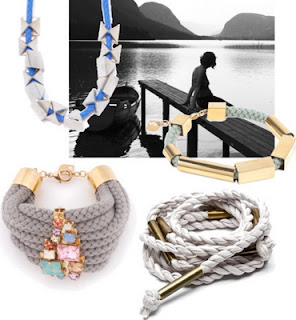
While rope on it's own would make a fairly indifferent piece, pair it with gold or silver, and interesting stones and viola some incredibly exclusive pieces.
Sabrina Dehoff Mint Single Cord Rope And Gold Plated Tube Bracelet, $101
Sabrina Dehoff Rope Bracelet With Gold Crystal Plate - Grey, 174 GBP
silver triangles & blue rope necklace for $129
Rope Belt for $330
I visited into one of my preferred stores in my Brooklyn neighborhood Stuart and Wright. Where I have never truly bought anything but I go to regularly to stare at all of the eye candy and beautifully crafted items (that I can't afford). Today I found something really extravagant...these beautiful baubles by Lizze Fortunato. I adore the tribal details and bohemian vibe of these pieces.
While rope on it's own would make a fairly indifferent piece, pair it with gold or silver, and interesting stones and viola some incredibly exclusive pieces.
Sabrina Dehoff Mint Single Cord Rope And Gold Plated Tube Bracelet, $101
Sabrina Dehoff Rope Bracelet With Gold Crystal Plate - Grey, 174 GBP
silver triangles & blue rope necklace for $129
Rope Belt for $330
I visited into one of my preferred stores in my Brooklyn neighborhood Stuart and Wright. Where I have never truly bought anything but I go to regularly to stare at all of the eye candy and beautifully crafted items (that I can't afford). Today I found something really extravagant...these beautiful baubles by Lizze Fortunato. I adore the tribal details and bohemian vibe of these pieces.
Labels:
Jewelries
Subscribe to:
Posts (Atom)